 Corterra Book
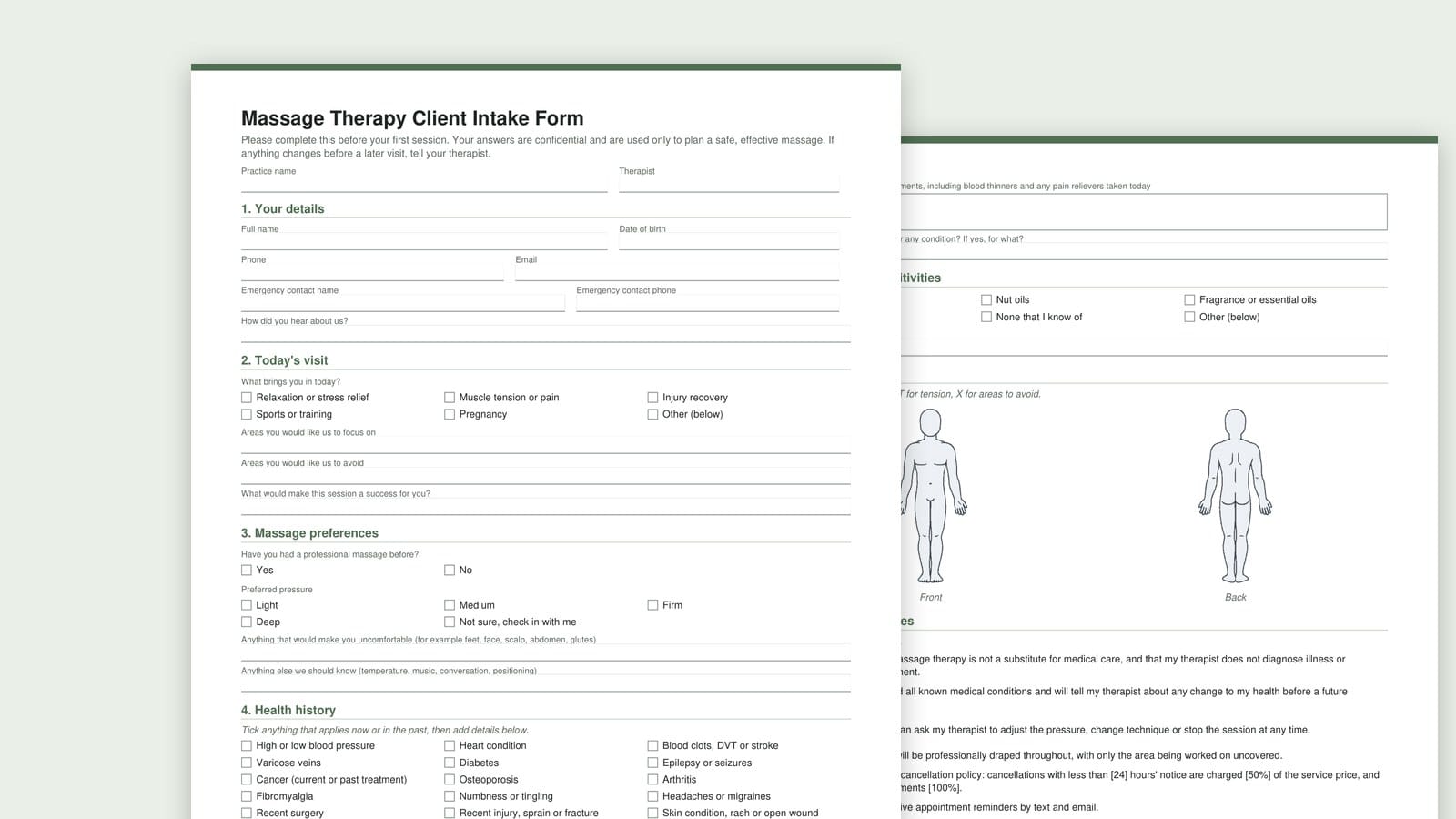
Most massage intake forms fall into one of two camps. There is the one-page clipboard sheet someone photocopied years ago, which asks for a name, a phone number and "any medical conditions?" and gets a dash in reply. And there is the four-page medical history that clients skim, tick "no" all the way down, and sign without reading.
Neither does the job. A useful intake form is short enough that clients answer it honestly and specific enough that the answers change what you do on the table. Below is a free template built to that standard, what each section is for, the answers worth following up on, and how often to have clients update it.
We make Corterra Book, booking software that includes digital intake forms, so we have an interest here. The template is free, needs no signup, and works on paper whether or not you ever look at our software.
Download the template: fillable PDF (type into it or print it) or Word version (edit it to fit your practice).
In a hurry? Jump to the template, section by section, the answers worth a conversation, how often to update it, or how Corterra Book approaches this.
What a massage therapy intake form is for
An intake form has three jobs, and it is worth knowing which one each question serves, because that is how you decide what to cut.
- Screening. Surfacing the conditions, medications and recent injuries that change whether, where or how firmly you work. This is the part that protects the client.
- Planning. What the client wants from the session: the areas to focus on, the areas to leave alone, the pressure they like. This is the part that makes the session good.
- A record. Their consent, your policies, and a signature and date showing they were told. This is the part that protects you.
What it is not: a diagnosis, or your treatment notes. The intake form is the client's account before the session. SOAP notes are your record of what you found and did, written after it. Plenty of practices keep both, and they belong in different places.
The template, section by section
The downloadable versions ask exactly these questions, laid out for print. Anything in square brackets is yours to change.
1. Your details
- Full name and date of birth
- Phone and email
- Emergency contact name and phone
- How did you hear about us?
Date of birth matters more than it looks: it is how you catch a client under 18, which usually means a parent or guardian signs too.
2. Today's visit
- What brings you in today? Relaxation or stress relief, muscle tension or pain, injury recovery, sports or training, pregnancy, or something else
- Areas you would like us to focus on
- Areas you would like us to avoid
- What would make this session a success for you?
"Areas to avoid" earns its place as much as "areas to focus on". A client who hates having their feet touched will rarely say so unprompted, and will rarely come back.
3. Massage preferences
- Have you had a professional massage before?
- Preferred pressure: light, medium, firm, deep, or not sure, check in with me
- Anything that would make you uncomfortable (for example feet, face, scalp, abdomen, glutes)
- Anything else we should know (temperature, music, conversation, positioning)
4. Health history
The client ticks anything that applies now or in the past:
Heart and circulation
- High or low blood pressure
- Heart condition
- Blood clots, DVT or stroke
- Varicose veins
Nerves, bones and joints
- Epilepsy or seizures
- Numbness or tingling
- Headaches or migraines
- Osteoporosis
- Arthritis
- Fibromyalgia
Everything else
- Diabetes
- Cancer (current or past treatment)
- Recent surgery
- Recent injury, sprain or fracture
- Skin condition, rash or open wound
- Contagious illness or fever
- Currently pregnant
- Medical device or implant
Then three follow-ups:
- Details of anything ticked (for pregnancy, how many weeks)
- Current medications and supplements, including blood thinners and any pain relievers taken today
- Are you under a doctor's care for any condition? If yes, for what?
5. Allergies and sensitivities
- Massage oils or lotions
- Nut oils
- Fragrance or essential oils
- Latex
- None that I know of, or something else
Nut oils are the one to watch, because sweet almond oil is a common base for massage oil.
6. Body diagram
A front and back outline where the client marks P for pain, T for tension and X for areas to avoid. It takes ten seconds and answers "where exactly?" better than any text box, especially for clients who do not know the name of the muscle that hurts.
7. Consent and policies
The client initials each statement:
- I understand massage therapy is not a substitute for medical care, and that my therapist does not diagnose illness or prescribe treatment.
- I have disclosed all known medical conditions and will tell my therapist about any change to my health before a future session.
- I understand I can ask my therapist to adjust the pressure, change technique or stop the session at any time.
- I understand I will be professionally draped throughout, with only the area being worked on uncovered.
- I have read the cancellation policy: cancellations with less than [24] hours' notice are charged [50%] of the service price, and missed appointments [100%].
- Optional: I agree to receive appointment reminders by text and email.
The cancellation line is where most forms go vague. State the window and the fee in numbers. What to charge and how to word it is in our massage cancellation policy and no-show fee guide.
8. Signature
- Client signature and date
- Parent or guardian signature and date, if the client is under 18
The answers worth a conversation before you start
Most ticks on a health history need nothing more than a quick question. A few change the session enough to raise before the client is on the table. What you do about them is a matter of your training, your state's scope of practice and, where it applies, the client's doctor. The form's job is only to make sure you hear about them.
- Blood thinners. Clients taking them can bruise more easily, which changes how much pressure is sensible.
- Pain relievers taken today. They can dull the feedback you rely on when a client tells you the pressure is too much.
- Blood clots, DVT or varicose veins. The classic areas not to work on directly, and the reason the form asks about history rather than only current conditions.
- Pregnancy. It changes positioning and, depending on the stage, what you offer, which is why the form asks for weeks.
- Recent surgery or injury. It tells you which area to leave alone and whether to ask about clearance from their doctor.
- Contagious illness or fever. Usually a reason to reschedule, which is easier to say before the session than during it.
- Anything under a doctor's care. A prompt to ask whether their doctor has said anything about massage.
How often clients should update it
- First visit: the full form.
- Every visit: one question, asked out loud or on a short check-in: "Anything changed since last time?" New injuries, new medications and pregnancies happen between appointments.
- Once a year: the full form again, so a regular of five years is not being treated off a health history from five years ago.
- After a major change: surgery, a new diagnosis, a pregnancy. Do not wait for the anniversary.
If you offer more than massage
A growing number of massage practices add a sauna, a cold plunge, an infrared cabin or a float tank. Each of those has its own screening questions, and they are not the massage questions: heat and cold exposure carry their own cautions around heart conditions, blood pressure and pregnancy, and a float tank cares about open cuts and skin conditions in a way a massage table does not.
The tempting move is to bolt all of it onto one form. Then every massage client answers questions about cold plunges they will never take, and every sauna guest fills in a body diagram. The better shape is one short screening per service, asked only of the people booking that service. We wrote about why this matters for multi-service businesses in wellness center software: booking rooms and equipment, not just staff, and about sauna waivers specifically in sauna booking software: what studio owners actually need.
Paper, PDF or online?
- Paper. Costs nothing and works for a solo practice. The catches: it gets filled in at the door, eating into the session; handwriting on a clipboard is hard to read; and the finished forms need a locked cabinet.
- Fillable PDF. Clients can type into it at home and send it back, which fixes legibility. It also puts health information in an email attachment, which is exactly where you do not want it sitting.
- Online, sent with the booking confirmation. The client fills it in on their phone before they arrive, you read it before they walk in, and it is stored with their record rather than in an inbox. For a practice that already takes bookings online, this is the version worth moving to.
Whichever you use, treat the answers as health information. HIPAA covers healthcare providers who handle certain transactions electronically, such as insurance billing, so many cash-pay massage practices fall outside it, but state privacy laws and your licensing board can still set rules about client records. If HIPAA does apply to you, ask any software vendor, us included, whether they will sign a business associate agreement before you store intake answers with them.
How Corterra Book approaches this
Intake forms are built into Corterra Book on both plans, $40 and $80 a month, alongside waivers and consent forms.
- Sent automatically. The form link goes out with the booking confirmation, so clients fill it in on their phone before they arrive rather than at the door.
- Per service, on a schedule. Assign a form to every client or only to those booking particular services, and choose whether it is signed once, every visit, or once a year. A massage intake and a sauna waiver sit side by side without every client seeing both.
- A body chart built in. Clients tap the front and back outline on their phone to mark areas, and the marks come through on the signed record.
- A record you can rely on. Each signature, typed or drawn, is stored with the date, the time and the exact version of the form that was signed, so editing the template later never changes what a client agreed to. The signed PDF is kept privately, not at a public link.
- Visible before the visit. The calendar and the front desk show whether a client has signed. On the $80 Pro plan, the check-in kiosk asks for any unsigned form before the client can check in.
- Groups sign individually. When one person books for several, each guest who claims their seat signs their own forms.
Where we fit badly:
- Lighter treatment charting. We have SOAP notes, signed and locked with dated addenda, but if your notes feed insurance claims, a documentation-first tool fits better. ClinicSense, Noterro and Jane are the usual choices, compared in ClinicSense vs MassageBook.
- No insurance billing. If you bill insurers, we are not a candidate.
- The kiosk gate is Pro only. On the $40 plan, forms still go out with the confirmation and show as signed or pending, but nothing blocks check-in automatically.
Massage intake form FAQ
What is a massage intake form? A questionnaire a client completes before their first massage, covering contact details, the reason for the visit, health history, medications, allergies and consent. It tells the therapist what to focus on, what to avoid, and whether anything about the client's health changes how the session should be done.
What should be included on a massage intake form? Contact and emergency details, the reason for the visit and the areas to focus on or avoid, pressure preferences, a health history checklist, current medications, allergies, a body diagram, consent statements, the cancellation policy, and a signature and date. The free template on this page covers all of them.
Is there a free printable massage therapy intake form? Yes. The template on this page is free with no signup, as a fillable PDF you can type into or print and as a Word document you can edit to fit your practice.
How often should clients update their intake form? Ask whether anything has changed at every visit, and have clients complete the full form again once a year or after a major change such as surgery, a new diagnosis or a pregnancy.
Do massage therapists need clients to sign an intake form? Requirements vary by state and by insurer. Many licensing boards require client records to be kept, and professional liability insurers commonly expect a signed intake and consent. Check your state massage board's rules and your policy, and have your insurer review the consent wording.
Should a massage intake form include a body diagram? It helps. A front and back outline lets a client mark pain, tension and areas to avoid in a few seconds, which is more precise than a written description, especially for clients who do not know the names of muscles.
Is an intake form the same as SOAP notes? No. The intake form is the client's account before the session. SOAP notes (subjective, objective, assessment, plan) are the therapist's record of what they found and did, written after it.
Can clients fill out a massage intake form online? Yes, and it is usually the better option. The client completes it on their phone before arriving, the therapist can read it before the session starts, and it is stored with the client's record rather than on paper or in an email inbox.
Does MassageBook have intake forms? Yes. According to MassageBook's pricing page in September 2026, client intake forms are included from its Practice plan, which is $59 a month or $44.25 for AMTA members.
Download the fillable PDF or the Word version and adapt it to your practice. If you would rather clients filled it in on their phone before they arrive, start a 15 day free trial of Corterra Book and attach it to your services.