 Corterra Book
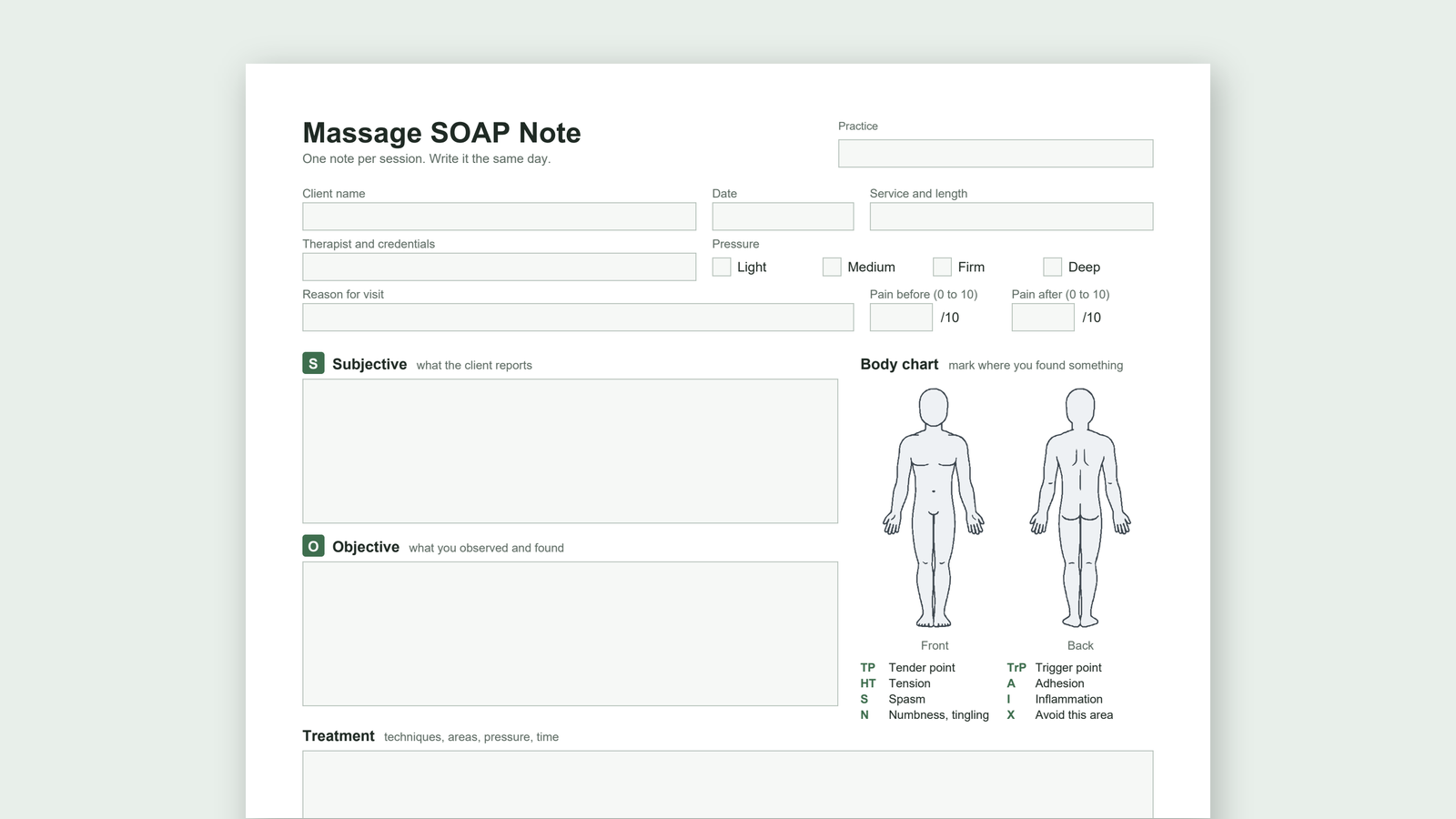
A SOAP note is the record of one massage session: what the client told you, what you found, how they responded, and what you plan to do next time. It is what you read before their next visit, and it is what a licensing board or an insurer asks to see if a session is ever questioned.
The format is simple. The work is keeping each note short enough to write between sessions and clear enough to use months later. Below is a free template laid out for massage, what to write under each letter, three sample notes, the common abbreviations, and how long to keep your records.
We make Corterra Book, booking software with SOAP notes built in, so we have an interest here. The template is free, needs no signup, and works on paper whether or not you ever use our software.
Download the template: fillable PDF (type into it or print it) or Word version (edit it to fit your practice).
In a hurry? Jump to three sample notes, the abbreviations, how long to keep them, or how Corterra Book approaches this.
What goes in a massage SOAP note?
SOAP stands for subjective, objective, assessment and plan. Each letter answers a different question about the session.
- S is what the client tells you.
- O is what you find, and what you do about it.
- A is how the client responded, and whether they are making progress.
- P is what happens next, at the next session and at home.
The template on this page adds a few lines around those four:
- A header with the client's name, the date, the service and its length, and your name and credentials
- A pain score before and after the session, on a 0 to 10 scale
- The pressure you used
- A front and back body chart for marking where you found something
- A signature and date
It also gives treatment its own line between O and A. Many massage SOAP formats do this, because it keeps what you found apart from what you did, and the note is easier to read back.
A SOAP note is a different thing from an intake form. The intake form is the client's account of their health before the first session. The SOAP note is your record of each session after it.
What do I write under S?
S is the client's own account, in their words or close to them. Write down:
- Why they came in today, and where it hurts or feels tight
- How long it has been going on, and what makes it better or worse
- Their pain on a 0 to 10 scale
- Anything new since the last visit, like a new medication, an injury, or a change at work or in training
- What they want from the session
Keep it to what the client reports. "Client reports R shoulder pain 6/10, worse after long days at the computer" belongs here. "R upper trapezius hypertonic" is something you found, so it goes under O.
What do I write under O?
O is what you observe and what you do. Write down:
- What you saw before you started, like posture, guarding or swelling
- What you found on palpation, by area and side, such as hypertonic tissue, trigger points, tender points or adhesions
- Any range of motion you checked, and what you saw
- The treatment: techniques, areas, pressure, and where you spent the most time
Be specific about side and location. "R upper trap" tells you where to start next time. "Tight shoulders" leaves you guessing. If you mark the body chart, the written note can be shorter, because the chart already shows where.
What do I write under A?
A is your assessment of how the client responded. It is also the section most likely to drift outside a massage therapist's scope of practice, so it helps to be clear about what goes in it.
- What changed during the session, such as tissue that released, range of motion that improved, and pain before and after
- How the client is progressing over several visits toward what they told you they want
- Any reaction to the treatment, good or bad
- Anything that should change how you work with them next time
A diagnosis does not belong in A. Massage therapists are not licensed to diagnose, so describe what you found and how it changed, and leave condition names to the client's doctor. "Client reports tingling down the R leg, unchanged by treatment. Suggested the client see their doctor before the next session" is a good A. Writing "sciatica" is not. If you refer a client out, note that too.
What do I write under P?
P is the plan. Write down:
- What to focus on next session, and when it should be
- Self-care you suggested, like stretches or changes to how they sit at work
- Anything to follow up on, like a referral or a question for the client's doctor
A good test for the whole note: could another therapist read it and know where to start? If yes, it has done its job.
Three sample massage SOAP notes
These are written the way a therapist writes between sessions, short and with the common abbreviations. A note this long takes two or three minutes. The abbreviations are spelled out in the next section.
1. A new client booked for relaxation
60 minute Swedish massage. First visit.
- S: New client. C/O general stress and "tight shoulders" from desk work, 4/10. Nothing of note on intake. Wants to relax and have neck and shoulders worked.
- O: Shoulders slightly elevated at rest. Mild HT in bilat upper trap and levator scapulae, R more than L. No TrP found.
- Treatment: FBM, Swedish, extra time on neck and shoulders. EFF, pet, light Fx on upper trap. Medium pressure, lighter on the back at client's request.
- A: HT in upper trap reduced. Client reports 1/10 after, neck "feels looser". No adverse reaction.
- P: Rebook in 3 to 4 weeks. Gentle neck stretches at the desk twice a day. Keep pressure medium on neck and shoulders, light on the back.
2. A regular client with low back pain
90 minute deep tissue massage. Fourth visit in 8 weeks.
- S: C/O LB pain 6/10, worse after sitting more than an hour. Was 4/10 at last visit. Client links the flare-up to a long drive last weekend. No numbness or tingling. New office chair since last visit.
- O: Guarding in bilat lumbar paraspinals. HT in R QL and R glute med. TrP in R glute med, referring into the R hip. Lumbar flexion limited, client reports pulling in LB at end of range.
- Treatment: DTM to lumbar paraspinals, QL and glutes. MFR to lumbar fascia. P/R on R glute med TrP. Firm pressure, checked in often on the R side.
- A: R glute med TrP released, referral into the hip no longer reproduced. Pain 3/10 after. Lumbar flexion improved, less pulling reported. Pain still above last visit's level.
- P: Rebook in 2 weeks, same focus, more time on R QL. Self-care: stand and walk every 45 minutes when sitting, knee-to-chest stretch. If pain goes above 6/10 or tingling starts in the leg, see a doctor before the next session.
3. A runner training for a race
60 minute sports massage. Race in 10 days.
- S: Training for a half marathon in 10 days. C/O tight calves, L more than R, 3/10 on hills. No injuries. Wants to feel loose for the race without being sore on race day.
- O: HT in bilat gastrocnemius and soleus, L more than R. TP in L medial gastroc. Mild HT in bilat hamstrings. Ankle dorsiflexion slightly limited on L.
- Treatment: Sports massage to bilat lower legs and hamstrings. Compression, pet, cross-fiber Fx on L medial gastroc. Medium to firm pressure, lighter over the TP.
- A: HT in calves reduced. L dorsiflexion close to R after treatment. Client reports 1/10. TP in L gastroc still present, less sensitive.
- P: One more session 3 to 4 days before the race, lighter pressure so there is no soreness on race day. Calf stretches after runs. Recheck L gastroc next visit.
What abbreviations do massage therapists use?
There is no single official list, and the same letters can mean different things in different places. TP is a tender point in some notes and a trigger point in others, and Fx is friction in many massage notes and a fracture in medical ones. Pick one meaning for each abbreviation and stick to it, so your notes still read correctly years later. These are the common ones, with the meanings used in the samples above.
| Abbreviation | Meaning |
|---|---|
| C/O | Complains of |
| Hx | History |
| FBM | Full body massage |
| DTM | Deep tissue massage |
| EFF | Effleurage |
| Pet | Petrissage |
| Fx | Friction |
| MFR | Myofascial release |
| P/R | Press and release |
| ROM | Range of motion |
| HT | Hypertonic, or tight, tissue |
| TP | Tender point |
| TrP | Trigger point |
| L, R | Left, right |
| Bilat | Both sides |
| LB | Low back |
| QL | Quadratus lumborum |
| SCM | Sternocleidomastoid |
| ↑, ↓ | Increased, decreased |
The body chart on the template uses its own short marks: TP for a tender point, TrP for a trigger point, HT for tension, A for an adhesion, S for a spasm, I for inflammation or swelling, N for numbness or tingling, and X for an area to avoid.
How long do I need to keep SOAP notes?
It depends on your state. Some massage boards set a minimum in their rules, and your professional liability insurer may ask for something longer. Washington, for example, requires massage therapists to keep records for adult clients for at least three years from the last treatment, and records for a client under 18 until three years after they turn 18. Other states set different periods. Check your state board's rules and your insurer's, and keep notes for the longer of the two.
A few habits hold up wherever you practice:
- Write the note the same day, while you still remember the session.
- Never erase or overwrite a finished note. If something was wrong, add a dated correction underneath and initial it.
- Keep notes where only you and the people who treat the client can read them. Your state and your licensing board may also have rules about how client records are stored.
How Corterra Book approaches this
SOAP notes are built into Corterra Book on both plans, $40 and $80 a month, on each client's record.
- One note per visit, attached to the appointment it belongs to.
- The same fields as the template on this page: reason for visit, history and changes, findings, treatment, response, and plan and homecare, plus pain before and after and the pressure you used.
- A front and back body chart you tap to mark, with the same eight marks as the template's legend.
- A draft can only be edited by the therapist who started it. Signing locks the note and records your name and credentials.
- A correction is a dated, signed addendum under the note, so the original stays as written.
- Any note can be printed on its own.
- On the Pro plan, each therapist writes and signs their own notes. Only the owner, managers and therapists who see clients can open them. A staff login that is not attached to a therapist's schedule, like a front desk account, does not see them at all.
Where we fit badly:
- No note templates or dictation yet. Each note starts from the empty fields.
- No insurance billing. If your notes back insurance claims, a documentation-first tool like ClinicSense or Jane fits better. We compared the common choices in ClinicSense vs MassageBook.
Massage SOAP notes FAQ
What does SOAP stand for in massage therapy? Subjective, objective, assessment and plan. S is what the client reports, O is what you find and do, A is how the client responded, and P is what happens next.
Do massage therapists have to write SOAP notes? It depends on your state and your insurer. Many massage boards require client records to be kept, and professional liability insurers commonly expect them. Rules usually ask for a record of each session, and SOAP is the most common way to keep one. If you bill insurance, expect to need them.
Can a massage therapist diagnose in a SOAP note? No. Diagnosis is outside a massage therapist's scope of practice. Describe what you found and how it changed, and if something needs a diagnosis, refer the client to their doctor and note the referral.
How long should a massage SOAP note be? A few lines per section is usually enough. The test is whether another therapist could read it and know where to start next session.
When should I write SOAP notes? As soon as you can after the session, and the same day at the latest. Details fade quickly, and a note written days later is harder to rely on.
How long do I need to keep SOAP notes? It depends on your state. Washington, for example, requires at least three years from the last treatment for adult clients, and longer for minors. Check your state board's rules and your liability insurer's.
Is there a free massage SOAP note template? Yes. The template on this page is free with no signup, as a fillable PDF you can type into or print and as a Word document you can edit.
What is the difference between SOAP notes and an intake form? The intake form is the client's account of their health before the first session. SOAP notes are your record of each session after it. Most practices keep both.
Download the fillable PDF or the Word version and adapt it to your practice. If you would rather write notes on the client's record from your phone or computer, start a 15 day free trial of Corterra Book.